Getting Started
LESS is a supervised learning algorithm that is based on training many local estimators on subsets of a given dataset, and then passing their predictions to a global estimator. You can find the details about LESS in our manuscript.
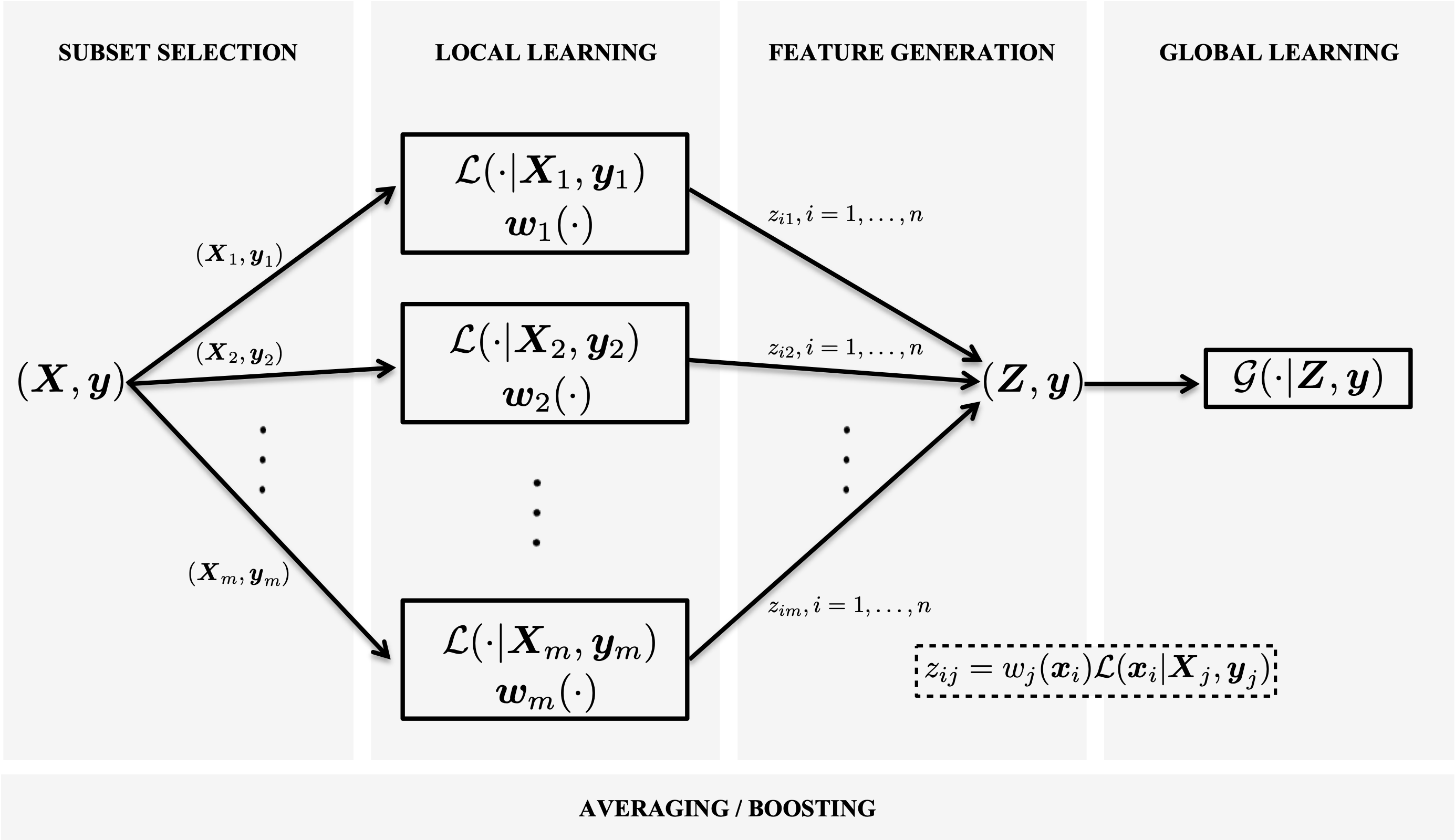
This guide provides a basic introduction to using the LESS library.
Installation
Install LESS from PyPI:
pip install less-learn
Example Usage
Below is a simplified example of how to use LESSBRegressor for a regression task.
from sklearn.datasets import make_regression
from sklearn.model_selection import train_test_split
from sklearn.metrics import mean_squared_error
from less import LESSBRegressor

# Generate a synthetic regression dataset
X, y = make_regression(n_samples=1000, n_features=20, random_state=42)

# Split into training and testing sets
X_train, X_test, y_train, y_test = train_test_split(
    X, y, test_size=0.3, random_state=42
)

# Initialize and train the LESS model
less_model = LESSBRegressor(random_state=42)
less_model.fit(X_train, y_train)

# Make predictions and evaluate performance
y_pred = less_model.predict(X_test)
mse = mean_squared_error(y_test, y_pred)
print(f"Test MSE of LESS: {mse:.2f}")
Note
LESS employs Euclidean distances combined with a radial basis function (RBF) kernel by default. It is therefore highly recommended to scale or normalize input features prior to model training to ensure optimal performance.
Citation
If you use LESS in your research, please cite our manuscript:
@misc{LESS,
  author = "Ilker Birbil",
  title = "LESS: Learning with Subset Stacking",
  year = 2025,
  url = "https://github.com/sibirbil/LESS/"
}